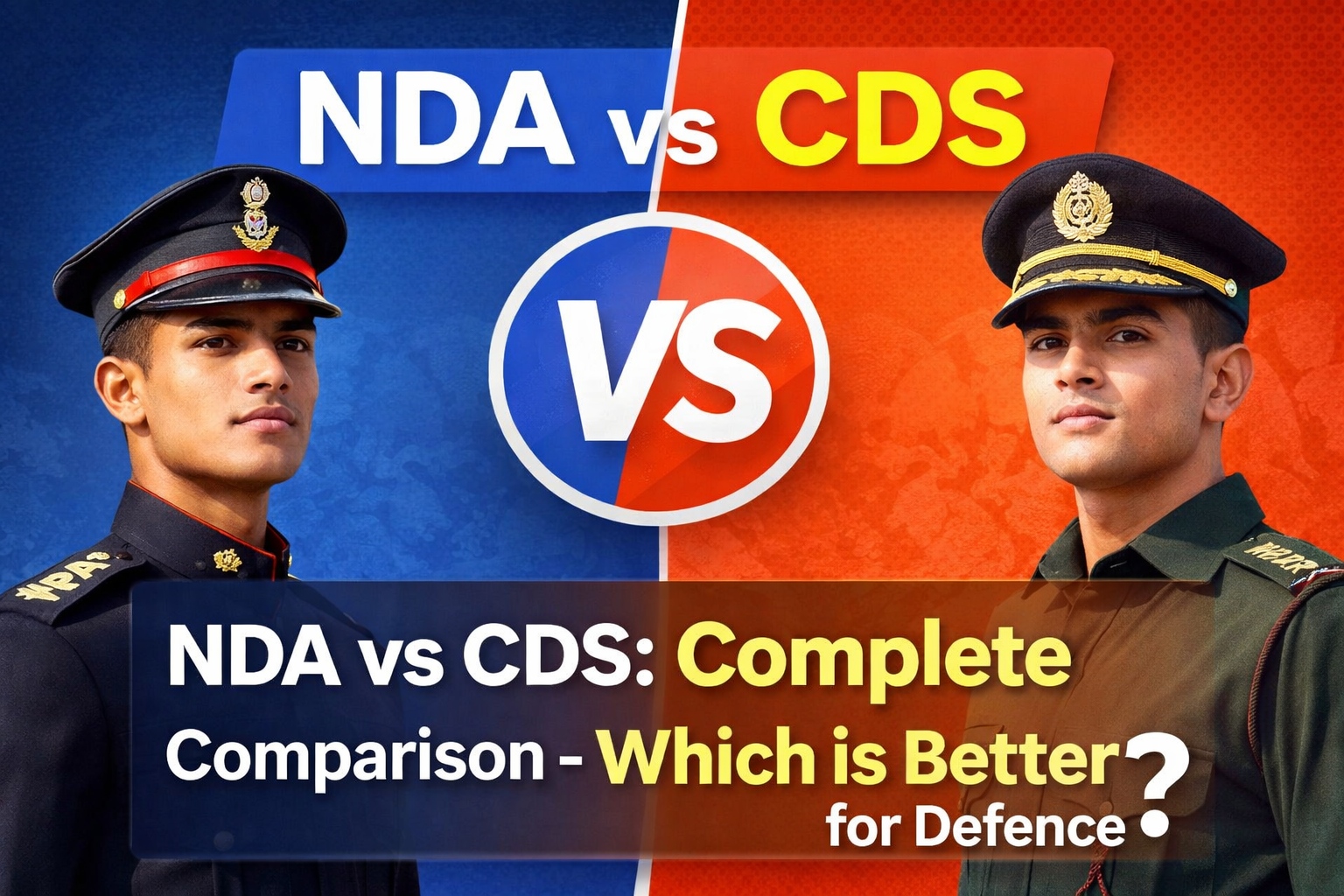
NDA vs CDS: Which Defence Entry is Better for You?
NDA vs CDS is one of the most common questions among defence aspirants in India.
Both examinations are prestigious entry routes to join the Indian Armed Forces,
yet they differ significantly in terms of eligibility, age, training, and career
path. Choosing the right defence entry at the right time is crucial for a
successful military career.
This blog provides a complete and clear comparison of NDA vs CDS to help
aspirants understand which exam suits their age, qualification, and long-term
goals.
What is NDA?
The National Defence Academy (NDA) examination is conducted for candidates who
wish to join the Indian Armed Forces immediately after completing their 12th
standard. NDA offers entry into the Army, Navy, and Air Force at a very young age,
allowing candidates to be trained from the foundation level.
Candidates selected through NDA undergo a three-year training program at the
National Defence Academy, followed by specialized training at respective
academies. NDA builds leadership, discipline, and officer-like qualities from an
early stage.
What is CDS?
The Combined Defence Services (CDS) examination is conducted for graduates who
aspire to join the Indian Army, Navy, or Air Force as commissioned officers. CDS
is suitable for candidates who decide to join the defence forces after completing
their graduation.
CDS candidates receive comparatively shorter training, as they are older and
already graduates. This entry is ideal for those who develop interest in defence
services during college or after graduation.
NDA vs CDS: Eligibility Criteria
- NDA: Candidates must have passed 10+2. For Army, any stream is allowed; for Navy and Air Force, Physics and Mathematics are mandatory.
- CDS: Candidates must be graduates. Engineering degree is required for Navy and Air Force entries.
NDA is meant for school-going aspirants, while CDS is for mature candidates with
higher educational qualifications.
Age Limit: NDA vs CDS
- NDA: Age limit generally ranges between 16.5 to 19.5 years.
- CDS: Age limit usually ranges from 19 to 25 years, depending on the academy.
NDA gives candidates an early start in defence life, whereas CDS allows candidates
to join after experiencing college life.
Exam Pattern Comparison
The NDA written examination consists of Mathematics and General Ability Test,
covering subjects like English, General Knowledge, Physics, Chemistry, History,
and Geography. The difficulty level is based on 10+2 standard.
The CDS written examination includes English, General Knowledge, and Elementary
Mathematics. The syllabus is broader and more analytical, suited for graduates.
Training Duration and Lifestyle
NDA cadets undergo nearly five years of combined training, including NDA and
respective academy training. This long training period helps in deep personality
development and leadership grooming.
CDS cadets undergo around one to one-and-a-half years of training, as they are
already graduates and older in age.
Salary and Career Growth
Both NDA vs CDS officers receive the same salary once commissioned, as pay is
based on rank and not on entry type. Career growth, promotions, and benefits are
equal for officers from both entries.
The difference lies only in the starting age and training exposure, not in
service benefits or respect.
to the same proud uniform.”
Which is Better: NDA vs CDS?
There is no absolute answer to which is better. NDA is ideal for candidates who
are determined to join defence forces at a young age and are ready for long-term
training. CDS is best for those who discover their passion later or wish to
complete graduation first.
The right choice depends on age, educational background, and personal readiness
for defence life.
NDA vs CDS are both honorable gateways to serve the nation. What matters most is
your dedication, discipline, and commitment to becoming a responsible officer in
the Indian Armed Forces.