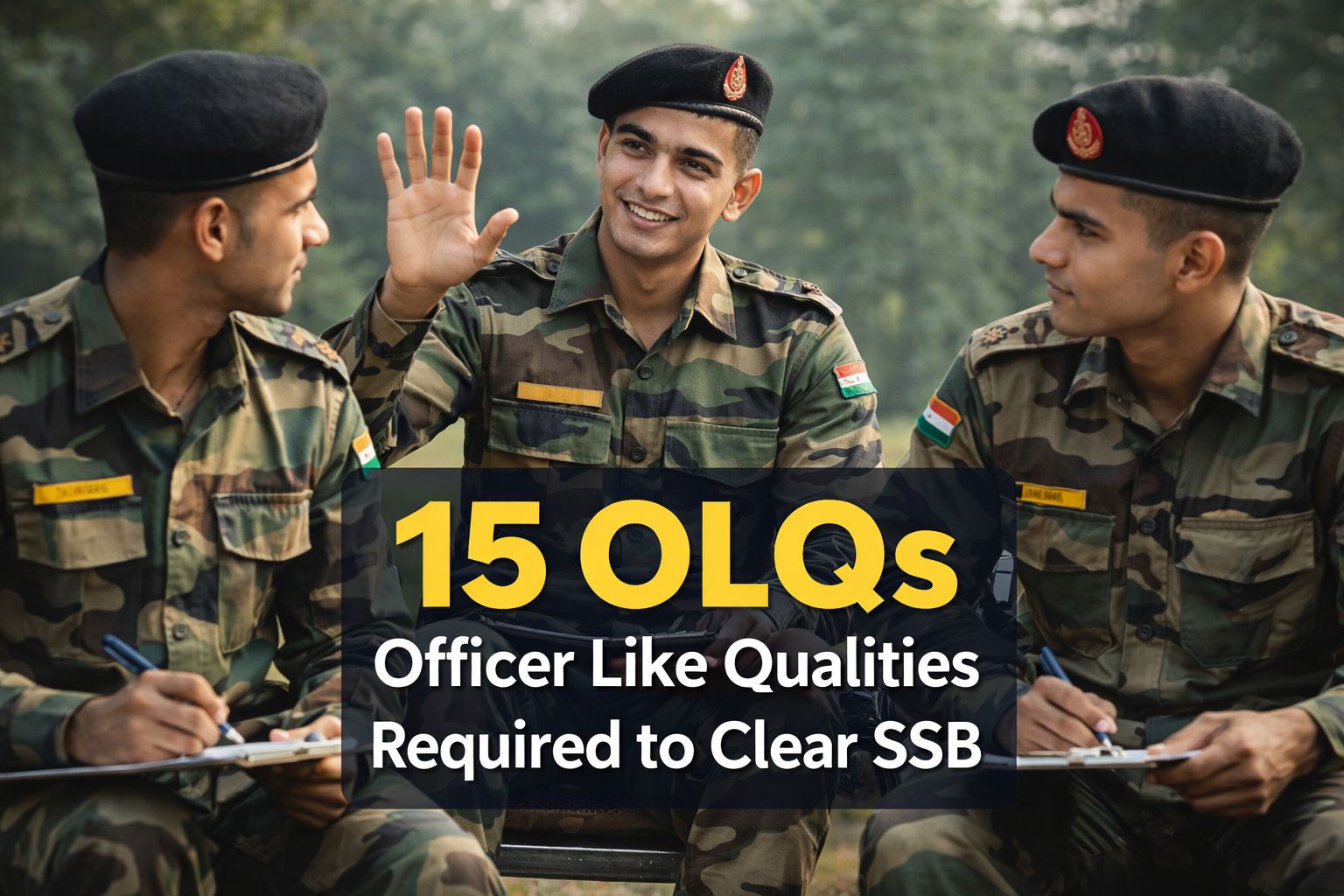
15 OLQs Explained: Officer Like Qualities Required to Clear SSB
15 OLQs are the foundation of the SSB interview process and play a decisive role
in the selection of future officers in the Indian Armed Forces.The Services Selection Board (SSB) interview does not judge candidates on marks,
degrees, or fluent English. Instead, it evaluates a candidate’s personality based
on a specific set of traits known as the Officer Like Qualities (OLQs). These
qualities indicate whether a candidate has the potential to become an effective
leader in the Indian Armed Forces.
The 15 OLQs are divided into four major factors: Planning & Organising,
Social Adjustment, Social Effectiveness, and Dynamic Factors. Understanding these
qualities clearly is the first step toward successful SSB preparation.
What are Officer Like Qualities (OLQs)?
Officer Like Qualities are the psychological and behavioural traits expected in
a defence officer. SSB assessors observe these qualities consistently during
psychological tests, GTO tasks, and the personal interview.
leadership potential, responsibility, and mental balance.
Group 1: Planning & Organising
1. Effective Intelligence
The ability to understand situations quickly and take logical decisions using
available resources.
2. Reasoning Ability
The capability to analyse problems logically and arrive at practical solutions.
3. Organising Ability
The skill to plan tasks, manage time, and utilise resources efficiently.
Group 2: Social Adjustment
4. Social Adaptability
The ability to adjust comfortably in different social environments and work with
diverse individuals.
5. Cooperation
Willingness to work as a team member and contribute to group success.
6. Sense of Responsibility
The habit of taking ownership of tasks and being accountable for actions.
Group 3: Social Effectiveness
7. Initiative
The readiness to take action without waiting for instructions.
8. Self-Confidence
Belief in one’s abilities while remaining humble and receptive.
9. Speed of Decision
The ability to make timely and appropriate decisions under pressure.
10. Ability to Influence the Group
The capacity to guide, motivate, and positively influence others.
11. Liveliness
Mental alertness, enthusiasm, and energy during tasks and interactions.
Group 4: Dynamic Factors
12. Determination
Persistence and commitment to complete tasks despite difficulties.
13. Courage
Mental strength to face fear, pressure, and challenging situations.
14. Stamina
Physical and mental endurance to perform consistently for long durations.
15. Integrity
Honesty, moral values, and consistency in words and actions.
How SSB Assesses the 15 OLQs
SSB does not test OLQs through direct questions. Instead, these qualities are
observed indirectly during TAT, WAT, SRT, GTO tasks, group discussions, and
interviews. Consistency across all tests is the key factor.
For example, leadership shown in group tasks should align with responses in
psychological tests and answers during the interview.
Can OLQs Be Developed?
Yes, OLQs are not inborn traits. They can be developed through disciplined living,
self-awareness, physical fitness, participation in group activities, and honest
self-improvement.
selection.
The 15 OLQs form the backbone of the SSB selection system. Candidates who focus on
personality development rather than shortcuts significantly increase their
chances of success. Understand the OLQs, live them daily, and SSB selection will
become a natural outcome.
The 15 OLQs are not checked in isolation during the SSB interview. Assessors look
for a consistent display of these qualities across all testing techniques,
including psychology tests, GTO tasks, and personal interview.
A candidate may show good performance in one test, but inconsistency in behaviour
across different situations often leads to rejection. This is why understanding
and developing the 15 OLQs holistically is extremely important.
The 15 OLQs reflect how a candidate thinks, behaves, interacts with others, and
handles pressure. These qualities are essential for leading troops, making quick
decisions, and maintaining discipline in challenging environments.
Candidates should focus on real-life application of OLQs such as taking
responsibility, working in teams, staying physically active, and maintaining
mental balance. Gradual improvement in daily life naturally reflects during the
SSB interview.
Instead of trying to display artificial confidence, aspirants should aim to live
the 15 OLQs consistently. SSB selection is a result of personality development,
not shortcuts.